


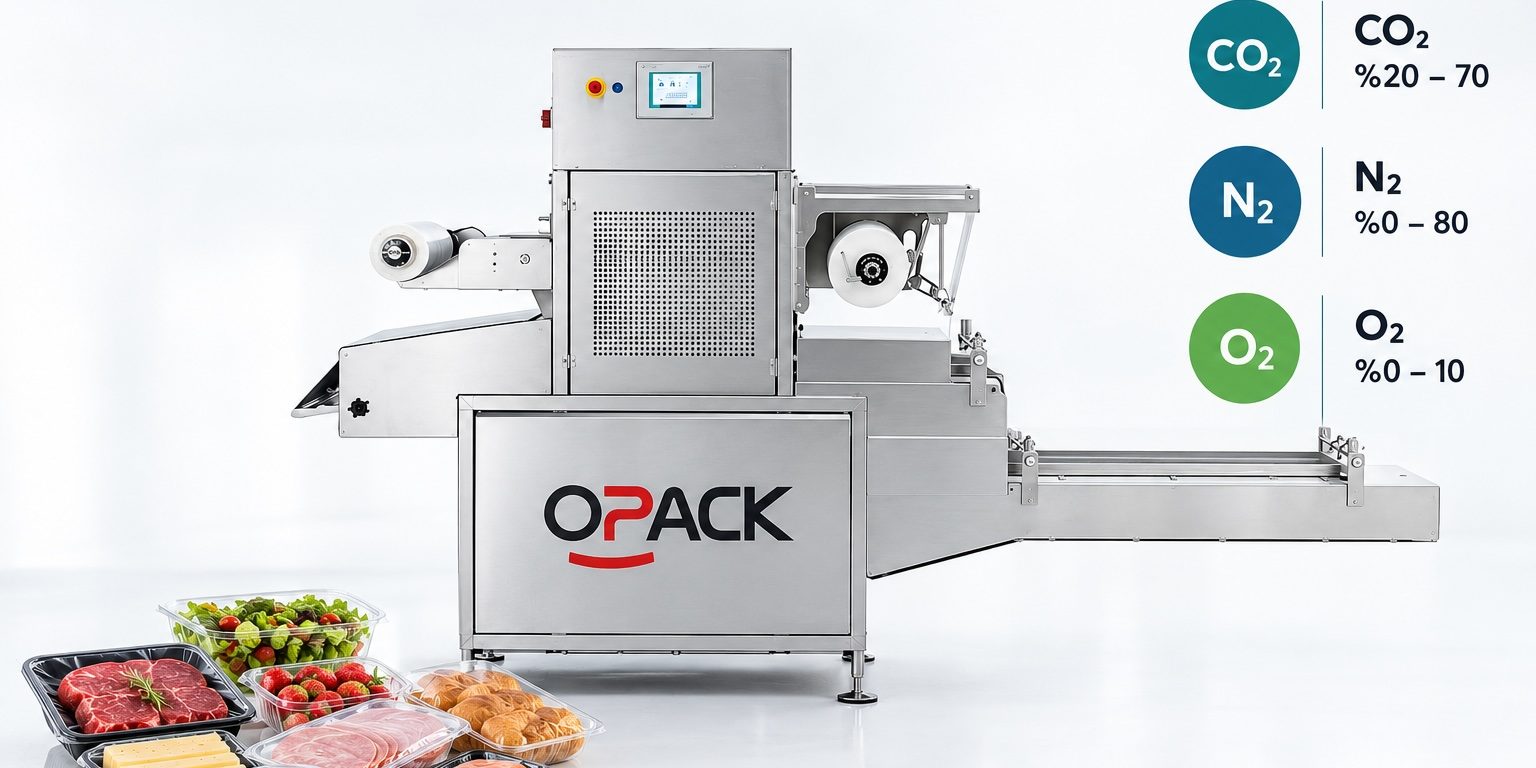
Modified atmosphere packaging (MAP) is a packaging method that extends the shelf life of food by replacing the air inside the package with a product-specific gas mixture. With the right gas ratio, the product lasts longer and keeps its color, texture and freshness.
What is Modified Atmosphere Packaging (MAP)?

In MAP, the product is placed in the package, the air inside is removed and replaced with a gas mixture containing carbon dioxide (CO₂), nitrogen (N₂) and, where needed, oxygen (O₂). The package is then sealed airtight. This slows down the causes of spoilage such as mold, oxidation and microbial growth.
An important feature of MAP is that there is no single “right” gas mixture. The atmosphere that suits cheese does not suit fresh meat. Bakery products face entirely different problems, such as pack collapse. This guide explains how MAP works, the role of each gas and the gas mixture ratios used for each product group.
MAP is widely used especially in the following sectors:
- Milk and Dairy Products
- Bakery Products
- Meat and Meat Products
- Ready-to-eat food products
- Sea products
- Liquid and flowable foods (yogurt, honey, jam, sauces)
- Dry food, fruit and vegetables
- Sterile medical products (thermoform packaging)
How Does MAP Work? The Role of CO₂, N₂ and O₂
Three gases stand out in MAP, and each has a different job. The success of the mixture depends on balancing these gases correctly for the product.
Carbon dioxide (CO₂)
CO₂ is the main preservative gas that suppresses the growth of mold and microorganisms. In meat and meat products, the atmosphere must contain at least 20% CO₂ to inhibit microorganisms. In mold-prone products such as cheese, the ratio is much higher.
CO₂ has two drawbacks. First, it dissolves in water and in the product. When the CO₂ in the headspace passes into the product, the pressure inside the package drops and the package collapses or shrinks. Second, when used alone in meat products, it can cause discoloration.
Nitrogen (N₂)
N₂ is an inert filler gas that is not absorbed by the product or the packaging. It prevents the package from collapsing and removes oxygen from the environment. It is the main component of the mixture in products such as yogurt. In meat products, an N₂ atmosphere leads to less drip loss than vacuum packaging.
Oxygen (O₂)
O₂ is removed from the environment in most products because it causes oxidation and aerobic spoilage. Even so, it is used deliberately in some products. Fresh red meat mixtures contain a high proportion of O₂. In sea products, having some O₂ in the package atmosphere is important to prevent risks such as botulism.
The difference between MAP and vacuum packaging
In vacuum packaging, the air is drawn out of the package and no gas is added. In MAP, after the air is removed, the package is filled with a gas mixture suited to the product. In some applications the two are used together. For example, in dairy products, oxygen is first reduced by vacuum before packaging, and then the appropriate atmosphere is created.
Gas Mixture Ratios by Product (Summary Table)
The table below summarizes the typical gas mixture ratios used for each product group. Ratios are given as percentages by volume.
| Product group | Recommended atmosphere (% by volume) | Why this mixture? |
| Hard and semi-hard cheese (whole, pieces, sliced) | 100% CO₂ or 95% CO₂ + 5% N₂ | Prevents mold and oxidative changes |
| Block cheese | 70% N₂ + 30% CO₂ | Reported as the most suitable ratio for block cheese |
| Sliced cheese | CO₂ + 10-20% N₂ | Prevents slices from sticking together |
| Yogurt, fruit yogurt | 75-80% N₂ + 20-25% CO₂ | N₂ acts as filler, CO₂ provides preservation |
| Fresh red meat | 80% O₂ + 20% CO₂ or 70% O₂ + 10% N₂ + 20% CO₂ | High O₂ preserves color, CO₂ suppresses microorganisms |
| Fresh chicken | 50% N₂ + 50% CO₂ | Limits discoloration and slows microbial growth |
| Meat and meat products (general requirement) | At least 20% CO₂ in the atmosphere | Minimum level required to inhibit microorganisms |
| Ready-to-eat food (milk-bread burgers, cold sandwiches, etc.) | At least 20% CO₂ | Prevents mold growth |
| Sandwich | 50-70% CO₂ (reported); better results can be obtained with 40% CO₂ | The optimum level varies by product |
| Intermediate-moisture dry food | Over 50% CO₂ or vacuum | Prevents mold growth at room temperature |
| Bakery Products | CO₂ + N₂ filler gas, residual O₂ in the pack below 1% | CO₂ suppresses mold, N₂ prevents the package from collapsing |
These values are typical ranges reported in the literature. The product's water activity, pH, initial microbial load, storage temperature and the gas permeability of the packaging material can change these values. The exact mixture should therefore be verified through trials for each product.
MAP in Dairy, Bakery and Meat Products
Milk and Dairy Products
Dairy products are sensitive, perishable foods. The packaging material and packaging conditions play a critical role in protecting the product from light, oxygen, moisture and microbial or chemical contaminants. During packaging, the oxygen level is reduced to below 0.1 mbar by vacuum. This prevents the product from molding and undergoing oxidative changes.
For cheese, the choice of gas depends on the shape of the product:
- Hard and semi-hard cheeses (whole block, pieces or sliced): 100% CO₂ or 95% CO₂ + 5% N₂
- Block cheeses: 70% N₂ + 30% CO₂
- Sliced cheeses: CO₂ with 10-20% N₂ to prevent the slices from sticking
PA + EVOH + PE, PET + EVOH + PE or PVC + EVOH + PE film combinations can be used as packaging material for these products. During storage, some gas loss may occur through CO₂ diffusion, and O₂ may enter the pack, albeit very slowly. Even so, the high CO₂ concentration in the pack is sufficient against mold growth.
Bakery Products
In bread, cakes, pastries and cream- or fruit-filled dough products, mold is the main cause of spoilage. For this reason, mold is one of the main factors determining shelf life in bakery products. Aerobic spoilage in pies, fruit cakes, pastries and pizzas sold raw or cooked can be significantly reduced by using CO₂ and lowering the storage temperature.
Two conditions must be met for flawless packaging:
- The residual oxygen level in the pack must be reduced to below 1%.
- A high-barrier packaging that prevents oxygen from entering and the protective gas from escaping must be used. PA + EVOH + PE, PET + EVOH + PE or PVC + EVOH + PE structures are preferred for this purpose.
A common problem when raising the CO₂ ratio is pack collapse or shrinkage. Because CO₂ dissolves readily in water, the gas in the headspace passes into the product and the pressure inside the pack drops. The solution is to inject N₂, which is not absorbed by the packaging or the product, as a filler gas.
In bakery products, shelf life depends not only on the gas mixture. Water activity, pH, microbiological load, the potassium sorbate concentration in the product and the storage temperature also directly affect durability.
Meat and Meat Products
MAP gives very positive results in meat and meat products. In studies, meat that lasted 2 weeks in aerobic packaging at 0 °C kept its properties for 3 months in a modified atmosphere at the same 0 °C. Other research findings are as follows:
- No signs of spoilage were observed for up to 6 weeks in chicken packaged in 100% CO₂ and stored at 3 °C.
- Salmonella was found not to grow in chicken kept below 10 °C with 80-100% CO₂.
- In minced meat kept for 10 days at 10 °C in an environment containing 60% CO₂, the Enterococcus count was 3 log units lower than in meat packaged in atmospheric gas.
- Beef produced under hygienic conditions could be stored for 6 months at -1.5 °C with CO₂ in gas-tight packaging.
The recommended gas mixtures for meat are as follows:
- Fresh red meat: 80% O₂ + 20% CO₂ or 70% O₂ + 10% N₂ + 20% CO₂
- Fresh chicken: 50% N₂ + 50% CO₂
Using CO₂ alone in meat products can cause discoloration. Using N₂ alone can also cause color changes. However, these atmospheres can be used for meats with no color issue, such as lamb, or for cured meats. Meats packaged in an N₂ atmosphere accumulate less drip than vacuum-packed meats.
On the packaging side, a 400-800 µm thick PVC + EVOH + PE or PET + EVOH + PE structure can be used for the bottom web, and a 70-80 µm thick PA + PE structure for the top film. Shelf life depends on the type and size of the meat, the initial microbial load, the storage temperature and the gas permeability of the packaging. A low initial microbial load and a low storage temperature are very important.
MAP in Ready Meals, Sea Products, Liquid Foods and Dry Foods
Ready-to-eat food products
In ready-to-eat foods such as milk-bread burgers, milk-bread wraps, cold sandwiches and breadsticks packaged with hazelnut spread or cream cheese, the optimum CO₂ level varies by product. The atmosphere must contain at least 20% CO₂ to prevent mold growth.
Some ready-to-eat foods are low in acid and are stored refrigerated (between -2 and +4 °C). The optimum CO₂ level for sandwiches is reported as 50-70%. However, better results can also be obtained with 40% CO₂.
Sea products
Research has shown that fish packaged with MAP or vacuum can be stored for longer. Less microbiological activity was observed in these products, and structure, color and other sensory properties remained unchanged for a long time. As a result, shelf life is extended significantly.
There is a critical point to watch in sea products. Packaging in a modified atmosphere can create a risk of anaerobic pathogens developing. The following measures must be applied together to manage this risk:
- Preservation, smoking and processing techniques suited to the product
- Cooking aimed at destroying toxins
- Proper sanitation and cooling
- Storage under the required cold conditions without exception
- Having some O₂ in the package atmosphere (to prevent problems such as botulism)
Liquid and flowable foods
Yogurt and fruit yogurt: PS (polystyrene) cups and aluminum foil lids are used for these products. The recommended gas mixture is 75-80% N₂ + 20-25% CO₂.
Honey and jam: The main component of honey and jam is 60-70% invert sugar (26-34% glucose, 38-41% fructose, 0.5-1.5% sucrose, 5-11% maltose). The water content is about 20%. The main cause of the microbial growth and spoilage that is occasionally seen is osmophilic yeasts. The basic principle of preventing spoilage is sterilization, which can be carried out with ozone or nitrogen.
Sauces: Sauces are minimally processed foods and have a limited shelf life. Most of them are low in acid and are stored refrigerated (-2 to +4 °C). The ingredients used in their preparation are mostly pasteurized.
Dry food, fruit and vegetables
Modified atmosphere packaging offers great benefits for dry foods. Foods with moderate moisture content that are stored at room temperature are packaged in an atmosphere containing over 50% CO₂, or under vacuum, to prevent mold growth. O₂ must also be present in the package environment.
In fruit and vegetables, the aim is to keep physiological changes under control and extend storage life. The common method is cold storage. Controlled atmosphere storage, used to strengthen the effect of cold, has gained importance in recent years. In this method, the respiration rate of the fruit is kept just above the anaerobic respiration level. In developed countries, extending shelf life with modified atmosphere applications has been commercially successful, especially for sliced vegetables.
For a product packaged in a modified atmosphere, the correct use of gas ratio, packaging material and temperature both increases shelf life and helps preserve quality.
Medical Products and Choosing Packaging Material
Packaging medical products
Packaging sterile medical products requires precision. The medical industry has high expectations of packaging. For this reason, all required hygiene standards must be met and thermoform packaging machines must be designed to suit each customer's individual requirements. Thermoform machines are preferred because they provide high efficiency, standardization and secure packaging.
Key advantages:
- Versatile equipment options with forming, sealing and cutting systems that can be custom-designed for the application area
- Easy-open feature
- Integration of various systems used for loading, marking, inspection and singulation
- High-efficiency production performance and maximum pack quality
How to choose the packaging material
No matter how right the gas mixture is, MAP does not work if the packaging cannot keep the gas inside. For this reason, gas-tight, high-barrier multilayer films are used. The typical structures used for each product group are as follows:
| Product group | Packaging structure |
| Cheese and dairy products | PA + EVOH + PE, PET + EVOH + PE or PVC + EVOH + PE |
| Bakery Products | High-barrier PA + EVOH + PE, PET + EVOH + PE or PVC + EVOH + PE |
| Meat and Meat Products | Bottom web (400-800 µm): PVC + EVOH + PE or PET + EVOH + PE. Top film (70-80 µm): PA + PE |
| Yogurt and fruit yogurt | PS (polystyrene) cup + aluminum foil lid |
The EVOH layer forms the oxygen barrier. The PE layer ensures the package is sealed leak-tight.
MAP Packaging Solutions from OPACK Makine
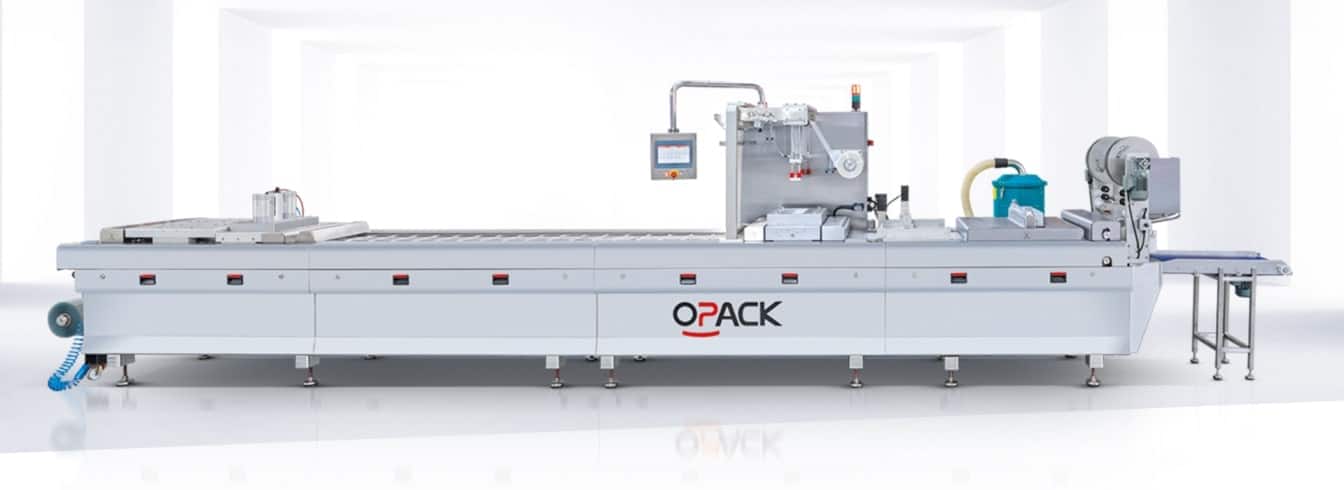
The right gas mixture delivers results only when combined with the right machine and the right packaging material. With over 25 years of experience and machines running in dozens of countries around the world, OPACK Makine offers fully automatic packaging solutions to the food and medical sectors.
Three main machine groups stand out for MAP applications:
- Termoform paketleme makineleri: Highly efficient, standard and secure packaging for cheese, meat products, bakery products and medical products
- Ready cup sealing machines (MAP): Modified atmosphere application in ready-made cups
- Forming, filling and sealing machines (FFS): For flowable and semi-flowable products such as yogurt
You can find packaging information specific to your sector on the following pages:
- Milk and Dairy Products
- Packaging of Bakery Products
- Packaging of Meat and Meat Products
- Packaging medical products
- Ready-to-eat food products
- Sea products
- Liquid and flowable food products
- Dry food, fruit and vegetables
If you are curious about the level of automation in cheese packaging, you can also check out our robotic thermoform-fed kashkaval cheese packaging application .
Frequently Asked Questions
What is MAP packaging used for?
MAP replaces the air inside the package with a gas mixture suited to the product, slowing down mold, oxidation and microbial growth. This extends the shelf life of the product and preserves quality characteristics such as color and texture.
Which gases are used in MAP?
CO₂, N₂ and O₂ are the most commonly used. CO₂ suppresses the growth of microorganisms and mold, N₂ is an inert filler gas and prevents the package from collapsing. O₂ is deliberately present in some products, such as fresh red meat and sea products.
What is the MAP gas ratio for cheese?
Hard and semi-hard cheeses are packaged with 100% CO₂ or 95% CO₂ + 5% N₂. For block cheeses, 70% N₂ + 30% CO₂ is the reported suitable ratio. For sliced cheeses, 10-20% N₂ is used together with CO₂ to prevent the slices from sticking.
Which gas mixture is used for meat products?
For fresh red meat, 80% O₂ + 20% CO₂ or 70% O₂ + 10% N₂ + 20% CO₂ is recommended, and for fresh chicken, 50% N₂ + 50% CO₂. The atmosphere must contain at least 20% CO₂ to inhibit microorganisms.
Why do MAP packs collapse?
CO₂ is highly soluble in water. When the CO₂ in the headspace passes into the product, the pressure inside the package drops and the package collapses. To prevent this, N₂, which is not absorbed by the packaging or the product, is injected as a filler gas.
Should MAP products be stored refrigerated?
Yes. MAP alone cannot replace the cold chain. For products such as meat, sea products, sauces and ready meals, a low storage temperature (-2 to +4 °C for ready meals and sauces) is very important for shelf life.
How do I determine the right gas mixture for my product?
The product's water activity, pH, initial microbial load, storage temperature and the gas permeability of the packaging material must be evaluated together. The exact mixture should be verified through trials with your product.
Conclusion
When applied correctly, modified atmosphere packaging extends shelf life and preserves product quality. However, success depends on three things together: a gas mixture suited to the product, a high-barrier packaging material and a packaging machine that applies both flawlessly. Differences such as 100% CO₂ for cheese, 75-80% N₂ for yogurt and high O₂ for fresh red meat show why the “one mixture suits every product” approach does not work.
Let's determine the most suitable MAP solution for your product together. Share your product group and production capacity, and OPACK Makine's experts will recommend the right machine and packaging structure for you. Get a quote now or reach us through our contact page .
Contact Now to Get Detailed Information